UK Government Grants for Tier 4 Study and Tier 2 Visa Sponsorship in 2026
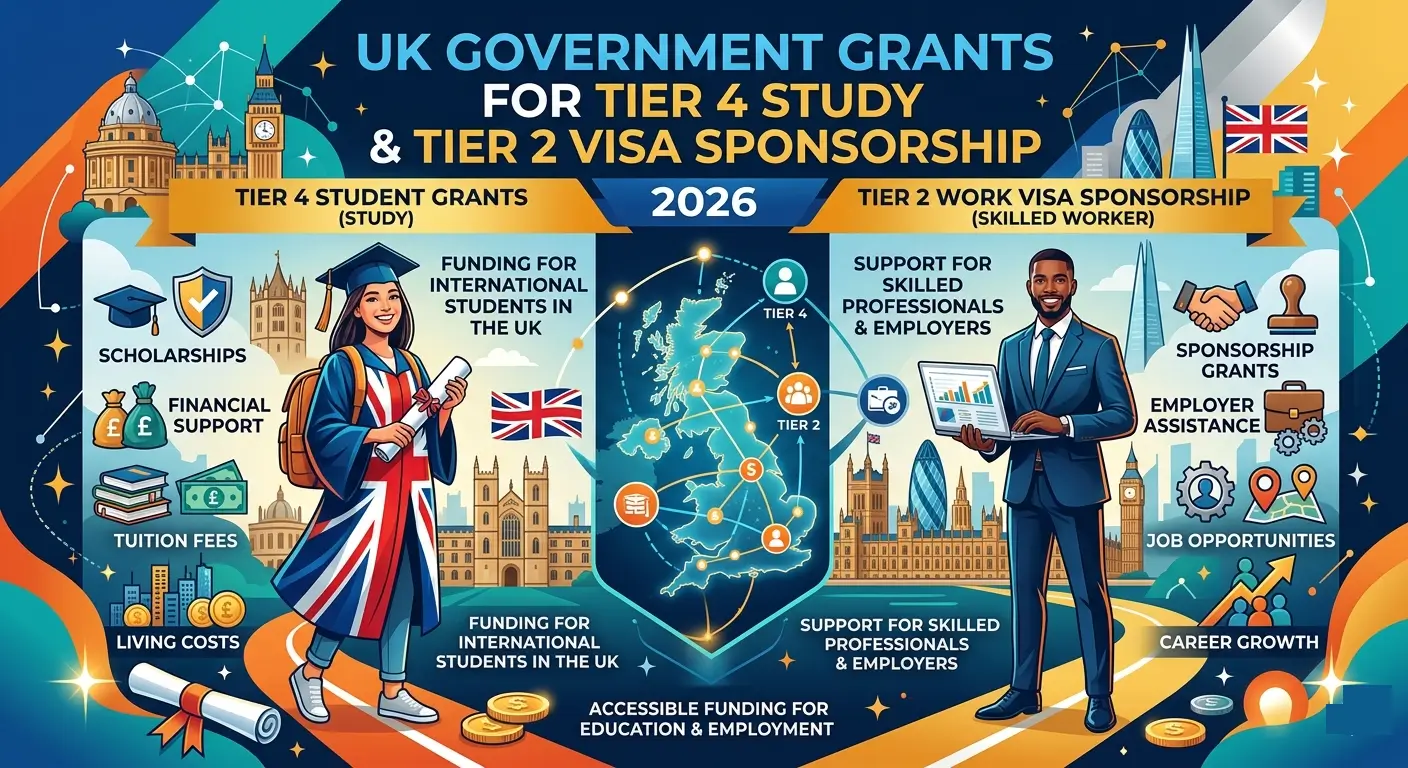
Most people who dream about moving to the United Kingdom hit the same two walls: tuition fees that feel impossible, and an immigration system that feels like a maze. But in 2026, the UK government has quietly made both of those problems much more manageable — if you know where to look.
The strategy is straightforward. Government-funded grants cover your education costs. Specific visa pathways turn your student status into a long-term career. And if you play it right, you can go from international applicant to permanent UK resident within seven years — without ever taking on crippling debt.
Understanding the Visa Journey Before You Apply for Anything
Your Starting Point — The Student Visa
Before grants, before jobs, before residency — this visa is where everything begins. When you receive a government scholarship, the award letter itself acts as your proof of funds. You don’t need to show a personal bank account with thousands of pounds sitting in it. The scholarship does that work for you.
In 2026, the Student Visa is more practical than it’s ever been. You can work up to 20 hours per week while classes are running and full-time during university holidays. That means you can build local work experience and earn money while you’re still studying — both of which make your transition to employment much smoother.
The Bridge Nobody Talks About — Graduate Visa
This is the most underused step in the whole process. Once you finish your degree, you automatically qualify for a Graduate Visa — no employer needed, no sponsorship required. It gives you two full years to live and work freely in the UK, or three years if you completed a PhD.
Think of it as a built-in runway. You have time to interview properly, find the right company, and negotiate a good offer — without the pressure of needing someone to sponsor you immediately after graduation.
The End Goal — Skilled Worker Visa
After you’ve settled into a role with a licensed employer, you move onto the Skilled Worker Visa. Mid-level positions in 2026 typically need to pay between £38,000 and £42,000 to qualify. From here, the path to permanent residency is clear — five years on this visa makes you eligible for Indefinite Leave to Remain, which is the UK’s version of a permanent resident status.
The Grants That Actually Cover Everything
Chevening — The UK’s Most Prestigious Scholarship
Chevening is funded directly by the UK government through the Foreign, Commonwealth & Development Office. It’s competitive, but what it offers in return is exceptional.
The total value typically falls between £50,000 and £65,000 depending on your course and university. That covers your full tuition, a monthly living stipend of roughly £1,600 to £1,900, your return flights, and a settling-in allowance for when you first arrive.
In 2026, applications in Climate Change, AI Ethics, and Global Health are being prioritized. If your background touches any of these areas, your application carries extra weight.
What Chevening is really looking for isn’t just academic performance. They want people who will go on to lead something — in their home country, in their industry, or in the relationship between nations. Your personal statement needs to reflect that ambition clearly.
Commonwealth Scholarships — Best for Professionals With Families
If you hold citizenship in a Commonwealth country, this scholarship deserves serious attention. It’s structured as a partnership between the UK government and individual universities, meaning both sides contribute to funding your place.
What separates Commonwealth Scholarships from most others is the family allowance. Certain programs provide additional financial support for a spouse or children — something almost no other scholarship does. For mid-career professionals who can’t simply leave their family behind, this changes everything.
GREAT Scholarships — More Universities, More Access
Run as a partnership between the British Council and more than 70 UK universities, GREAT Scholarships offer a minimum of £10,000 per award. They’re not always described as “fully funded,” but in many cases the scholarship is paired with a university-specific fee waiver that brings your remaining cost down to zero.
These are worth applying for even if you’re also pursuing Chevening or Commonwealth funding. The application process is less intensive, and winning a GREAT Scholarship can strengthen your wider profile.
Fields That Open Doors Faster Than Others
Healthcare — Where the Demand Is Loudest
The NHS and private healthcare sector are not quietly looking for talent. They are actively competing for it internationally. Clinical Researchers, specialized Nurses, and Public Health Analysts are among the most urgently needed professionals in 2026.
Beyond the job security, healthcare workers get practical benefits during the visa process too. Priority processing is common for NHS-related roles, and many healthcare professionals are exempt from the Immigration Health Surcharge — a fee that can otherwise add thousands of pounds to your application costs.
Artificial Intelligence and Data Science — High Pay From Day One
The UK has made its ambition clear: it wants to be a global leader in artificial intelligence. That goal requires a steady pipeline of engineers, researchers, and specialists — many of whom aren’t currently in the country.
Machine Learning Engineers, Data Architects, and Cybersecurity professionals who graduate from UK universities in 2026 are regularly seeing starting offers above £60,000. That’s well above the minimum threshold needed for Skilled Worker Visa sponsorship, which means transitioning from Graduate Visa to sponsored employment is a much smoother step in these fields.
Renewable Energy — Government Priority, Real Job Security
The UK has committed to reaching Net Zero, and that commitment requires engineers. Wind, solar, and nuclear energy specialists are listed as high-priority roles for both grant funding and visa sponsorship. If your background is in engineering and you can align it toward green energy, you’re entering one of the most supported sectors in the country right now.
A Realistic Step-by-Step Plan for 2026
Getting Your University Offer First — Don’t Skip This Step
No grant application and no visa application can move forward without an unconditional university offer in hand. This is step one, and it needs to happen before everything else.
Apply between August and October for courses starting the following year. Target research-active universities — institutions like Manchester, Leeds, Birmingham, and Sheffield have strong government partnerships, active industry connections, and dedicated international support teams.
Writing a Personal Statement That Actually Wins Funding
For Chevening and Commonwealth applications, your academic record matters — but it’s only half of what reviewers are looking for. The other half is your story.
You need to answer two things convincingly. First, how will this degree help your home country when you return? Second, how will you build real connections between the UK and your region during and after your studies? Generic answers don’t win competitive scholarships. Specific plans with named industries, organizations, or goals do.
Using Your Scholarship Letter as Proof of Funds
Once you’ve been awarded a grant, the official award letter replaces the need to show personal savings. You submit it as part of your visa application, and the Home Office accepts it as financial evidence. This is one of the most practical benefits of scholarship funding — it removes the biggest document barrier for most international applicants.
What the Seven-Year Journey Looks Like in Practice?
This isn’t a quick process, but it is a predictable one. Here’s an honest timeline of how it typically unfolds:
Year One — You arrive on a Student Visa, your fees fully covered by a government grant. You focus on your studies and start building professional contacts through university events, internships, and part-time work.
Years Two and Three — Your degree is complete. You switch to the Graduate Visa, which needs no employer sponsorship. You interview freely, take on roles, and figure out which sector and company feels right for your long-term career.
Years Four Through Six — You’ve proven your value to an employer. They sponsor your Skilled Worker Visa. Your salary is growing, your professional network is established, and you’re building the five-year residency record you need.
Year Seven — You apply for Indefinite Leave to Remain. If your record is clean and your employment history is solid, approval is straightforward. You are now a permanent resident.
Why Applying in 2026 Specifically Makes Sense?
The UK’s current economic strategy is built around innovation and growth. To achieve that, the government needs skilled professionals coming in — and it’s willing to fund their education to make that happen. Grants are essentially the UK pre-investing in people it wants to keep.
For professionals in data, healthcare, engineering, and related fields, this alignment of financial support and genuine job demand is rare. The grants reduce your upfront risk. The Graduate Visa removes early pressure. The labor shortage in key sectors means employers are ready to sponsor you once you’ve demonstrated what you can do.
The combination of all three doesn’t come together this cleanly very often. In 2026, it does.
Final Thought
Getting a UK government grant isn’t just about being academically strong — plenty of strong candidates apply and don’t win. What separates successful applicants is positioning. Choosing the right field, telling a compelling story about your future impact, and understanding how each visa step connects to the next — that’s what turns a good application into a funded one.
Start early, apply strategically, and treat the whole process as a long-term plan rather than a single lucky break.